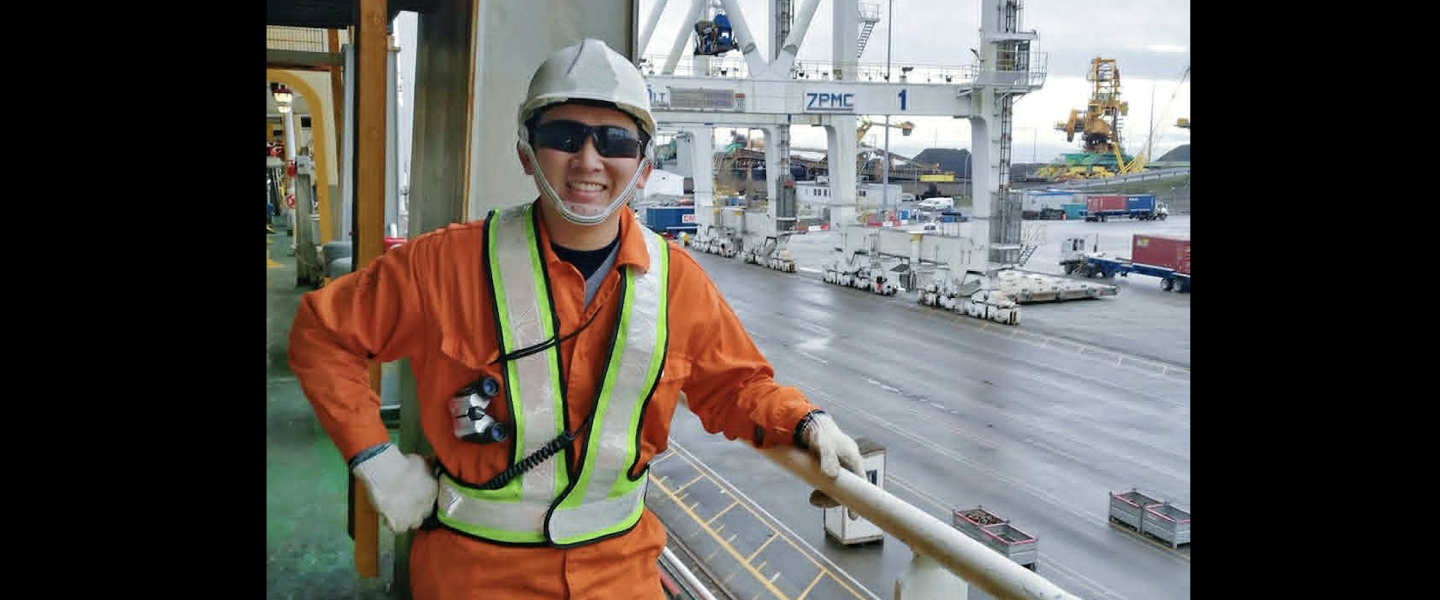
It is with much pleasure that Human Rights at Sea today announces that Captain James T. H. Foong has joined HRAS as a Global Ambassador for the Asia - Pacific Region.
As a Global Ambassador - APAC, Captain James T. H. Foong brings the perspective of a serving Master Mariner who has lived and worked within the realities of modern seafaring. His focus will be on strengthening awareness of seafarer welfare, fair treatment, human dignity, and the gap that still exists between written policy and lived experience at sea.
In Captain Foong’s view, seafarers are too often discussed from ashore, but not always listened to from sea. Many of the issues affecting crew welfare are not new. They include communication access, shore leave, fatigue, mental wellbeing, fair treatment, reporting culture, career progression, and the dignity of ratings and junior seafarers. These concerns are sometimes hidden behind formal compliance language, even when the lived experience onboard tells a different story.
One example is access to communication. In today’s world, the ability of seafarers to contact their families should not be treated as a privilege to be granted or withdrawn casually. For crew members working in isolated, high-pressure environments, communication is directly linked to mental wellbeing, morale, and dignity. Where such access is restricted without clear, fair, and transparent policy, it raises a broader question about how welfare is understood onboard.
Captain Foong also believes that the industry must confront the cultural silence that exists at sea. Many seafarers do not speak up because they fear being labelled difficult, ungrateful, or unsuitable for promotion. This is particularly true for ratings and junior crew, who may already face rank-based barriers and limited career progression. A maritime system that asks seafarers to be resilient must also be honest enough to ask whether it has created conditions where speaking up is safe.
Improvement requires more than slogans, conferences, and welfare campaigns. It requires companies, managers, Masters, unions, regulators, and welfare organisations to examine whether their systems genuinely protect seafarers in practice, not only on paper. Human rights at sea must be treated as an operational responsibility, not simply a public relations statement.
Through the Global Ambassador - APAC role, Captain Foong hopes to support HRAS by bringing operational reality into the human rights conversation. His aim is to help ensure that the voices of seafarers, especially those least heard, are represented with accuracy, dignity, and practical urgency across the APAC region and the wider maritime sector.
Founder, David Hammond said: "James has long been an ardent supporter for seafarer's rights and the ongoing drive to improve working conditions at sea. We are delighted that he has thrown his energy and weight behind Human Rights at Sea, as our mission to end abuse at sea evolves since our inception in 2013."
ENDS.
Meet our Ambassadors
Source: Human Rights at Sea 2026.
Photo credit: Captain James T. H. Foong 2026.
AI. AI was not used in the drafting of this article.
Photo Credit: Human Rights at Sea.
Contact: If you have any questions, please write to us at enquiries@hrasi.org.
About Sharing. We welcome the use and dissemination of our copyrighted work with full, accurate and proper accreditation. Open Access This article is licensed under a Creative Commons Attribution 4.0 International License, which permits use, sharing, adaptation, distribution and reproduction in any medium or format, as long as you give appropriate credit to the original author(s) and the source, provide a link to the Creative Commons licence, and indicate if changes were made. The images or other third-party material in this article are included in the article's Creative Commons licence, unless indicated otherwise in a credit line to the material. If material is not included in the article's Creative Commons licence and your intended use is not permitted by statutory regulation or exceeds the permitted use, you will need to obtain permission directly from the copyright holder. To view a copy of this licence, visit http://creativecommons.org/licenses/by/4.0/.
©Copyright and Intellectual Property of Human Rights at Sea CIC (HRAS) 2025. All rights reserved.