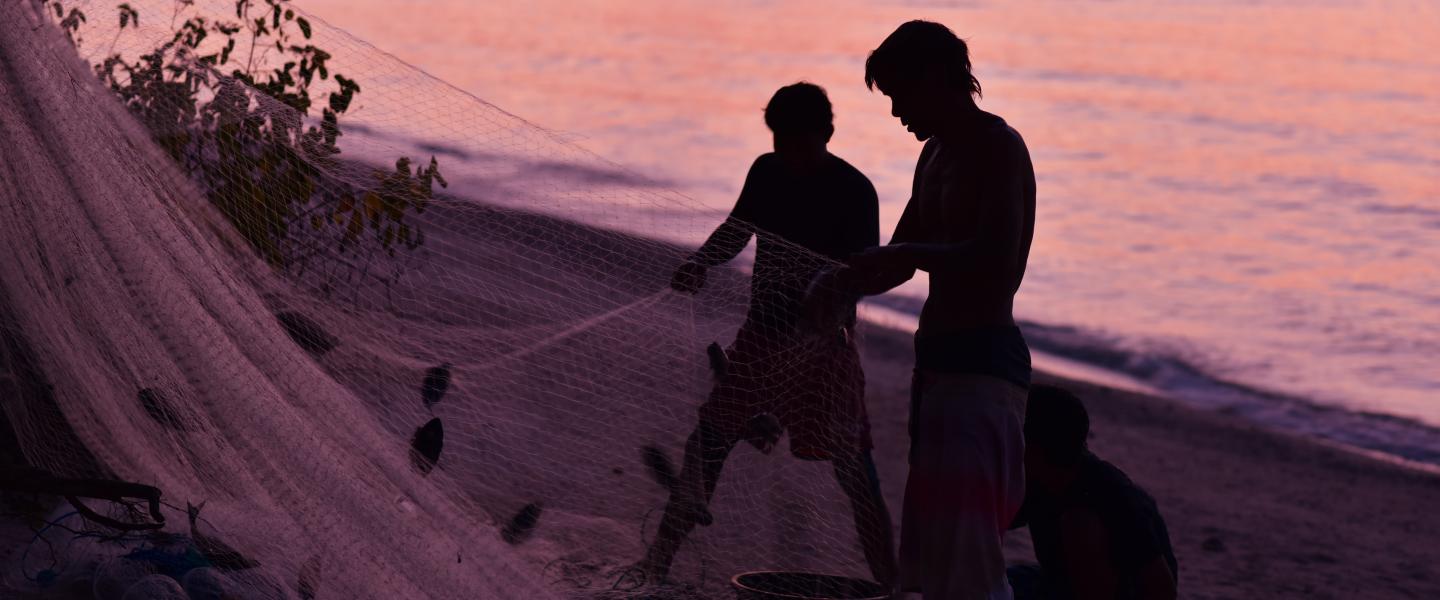
This World Fisheries Day (21 November) Human Rights at Sea highlights the prevalence of forced labour in the Indonesian fishing industry.
The ILO’s 2025 report Understanding working conditions of fishers in Indonesia, based on a survey of fishers from 18 Indonesian ports, indicates that those subjected to forced labour often face hazardous conditions that make them fear for their safety. They endure gruelling working hours without adequate food and water and are unable to voice complaints without significant negative consequences, including physical violence.
However, in a positive development for the fight against forced labour, Chief Judge Cynthia Bashant of the US federal court in San Diego, California, allowed the case of four Indonesian fishers who sued U.S. tuna brand Bumble Bee to move forward on 12 November.
The allegations in the lawsuit Akhmad v. Bumble Bee Foods LLC, No. 3:25-cv-00583 include accounts of physical violence, emotional abuse, untreated life-threatening and deformity-causing injuries, debt bondage, excessive working hours, lack of payment, and financial threats against family members.
Complainant Akhmad recalls: “One time, the rope holding the weighing gear broke and dropped a load of fish on me, cutting my leg open from thigh to shin. I was ordered to keep working. I thought there was water filling my boot, but I realized it was my own blood. I could see the bone in my leg. I was left to clean and bandage my leg myself, without sterile medical supplies, and I kept bleeding for two weeks. It still hurts and probably always will.
“So many men are out there right now, trapped in the same dangerous situation that I was. They deserve to work free from abuse, to be paid fairly, and to be able to leave their jobs rather than be trapped against their will.”
Over 128,000 fishers globally are estimated to be victims of forced labour, says Human Rights at Sea Founder David Hammond. “While there are known gaps in human rights protections in law and policy, the real factor in achieving positive change is the sustained and effective enforcement of existing legal instruments to underpin an increased deterrent effect against abusers.
“The advance of the Akhmad versus Bumble Bee Foods case pushes existing enforcement measures forward. Cases such as this can generate positive momentum for change in Indonesia, and around the world, and should be celebrated this World Fisheries Day.”
Source: Greenpeace. Human Rights at Sea 2025. Reporting by Wendy Laursen.
AI. AI was not used in the drafting of this article.
Photo Credit:Shutterstock and Greenpeace.
Contact: If you have any questions, please write to us at enquiries@hrasi.org.
About Sharing. We welcome the use and dissemination of our copyrighted work with full, accurate and proper accreditation. Open Access This article is licensed under a Creative Commons Attribution 4.0 International License, which permits use, sharing, adaptation, distribution and reproduction in any medium or format, as long as you give appropriate credit to the original author(s) and the source, provide a link to the Creative Commons licence, and indicate if changes were made. The images or other third-party material in this article are included in the article's Creative Commons licence, unless indicated otherwise in a credit line to the material. If material is not included in the article's Creative Commons licence and your intended use is not permitted by statutory regulation or exceeds the permitted use, you will need to obtain permission directly from the copyright holder. To view a copy of this licence, visit http://creativecommons.org/licenses/by/4.0/.
©Copyright and Intellectual Property of Human Rights at Sea CIC (HRAS) 2025. All rights reserved.