
In a time of increasing political polarity globally, the doctrine of human rights at sea was met with a welcome show of unity in the UK Parliament in February.
Members of the House of Lords met under the leadership of Minister of State for International Development Rt Hon Baroness Jenny Chapman to discuss amendments to the BBNJ bill that will enable the UK, having ratified the treaty, to then adopt it into law.
The BBNJ Agreement (Biodiversity Beyond National Jurisdiction), or High Seas Treaty, is a legally binding UN treaty adopted in 2023 to protect marine life in international waters. It entered into force on 17 January 2026.
Human Rights at Sea patron Lord Teverson of Tregony introduced an amendment to the UK legislation that would specifically include reference to human rights in relation to the licensing of vessels operating on the high seas. While the amendment was subsequently withdrawn at the Minister’s request, Lord Teverson is pleased that the concept behind the amendment was welcomed by representatives from both political parties.
“I was pleased to raise the issue of human rights at sea in Parliament and for the support from other members of the House of Lords. Crews at sea can be uniquely vulnerable to abuse and intimidation. It is important to raise these issues with Government. I hope that with further meetings with ministers we will be able to promote further safeguards and action.”
Baroness Chapman said she recognised the importance of the issue and that the government would keep the matter under constant review even though she did not believe this legislation was the appropriate place for the Lord’s intervention.
“While it was not successful, the fact that it was tabled, considered, and then debated with UK government engagement has once again placed the issue of human rights’ protections at sea into the official record of the UK Parliament,” said David Hammond, Founder of Human Rights at Sea.
“We believe that seafarers’ working conditions are likely to have an impact on their ability and inclination to promote marine conservation and sustainability, particularly where poor labour conditions and pay are connected to profits.
“Meanwhile, for many people, marine biological diversity is the foundation of their livelihoods and guarantees their economic, social and cultural rights. The protection of the rights of those people will be closely connected to their ability to protect the marine environment.”
The question of what the government could do to protect human rights at sea was first raised by Lord Teverson in the UK Parliament in June 2021, and his engagement continues unabated.
____
Submitted UK Bill Ammendment (Not taken on)
Clause 14, page 10, line 37, at end insert—
“(2A) In section 69 (determination of applications), after subsection (1)(c) insert—
“(d) the need to ensure the human rights of those at sea in areas beyond national jurisdiction,”
Member's explanatory statement
This amendment amends the Marine and Coastal Access Act 2009, to ensure that licensing authorities have regard to the human rights of seafarers within the context of offering marine licenses.
Hansard
https://hansard.parliament.uk/Lords/2026-01-19/debates/63CEFB5B-9806-4AC3-84F3-6E2F647F4A66/BiodiversityBeyondNationalJurisdictionBill Lord Teverson intervention.
____
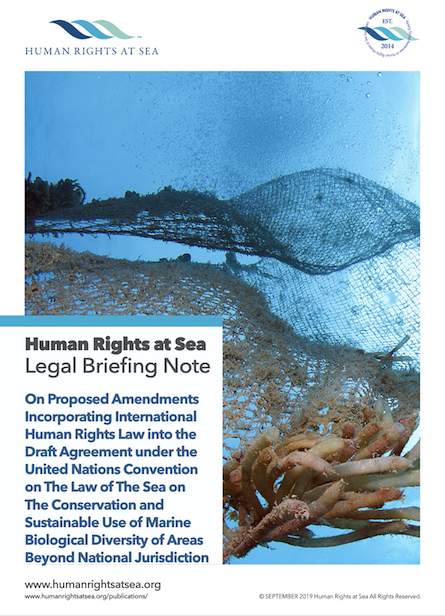
HRAS 2019 Briefing Note - HERE
ENDS.
Source: Human Rights at Sea 2026. Reporting by Wendy Laursen.
AI. AI was not used in the drafting of this article.
Photo Credit: Shutterstock.
Contact: If you have any questions, please write to us at enquiries@hrasi.org.
About Sharing. We welcome the use and dissemination of our copyrighted work with full, accurate and proper accreditation. Open Access This article is licensed under a Creative Commons Attribution 4.0 International License, which permits use, sharing, adaptation, distribution and reproduction in any medium or format, as long as you give appropriate credit to the original author(s) and the source, provide a link to the Creative Commons licence, and indicate if changes were made. The images or other third-party material in this article are included in the article's Creative Commons licence, unless indicated otherwise in a credit line to the material. If material is not included in the article's Creative Commons licence and your intended use is not permitted by statutory regulation or exceeds the permitted use, you will need to obtain permission directly from the copyright holder. To view a copy of this licence, visit http://creativecommons.org/licenses/by/4.0/.
©Copyright and Intellectual Property of Human Rights at Sea CIC (HRAS) 2025. All rights reserved.