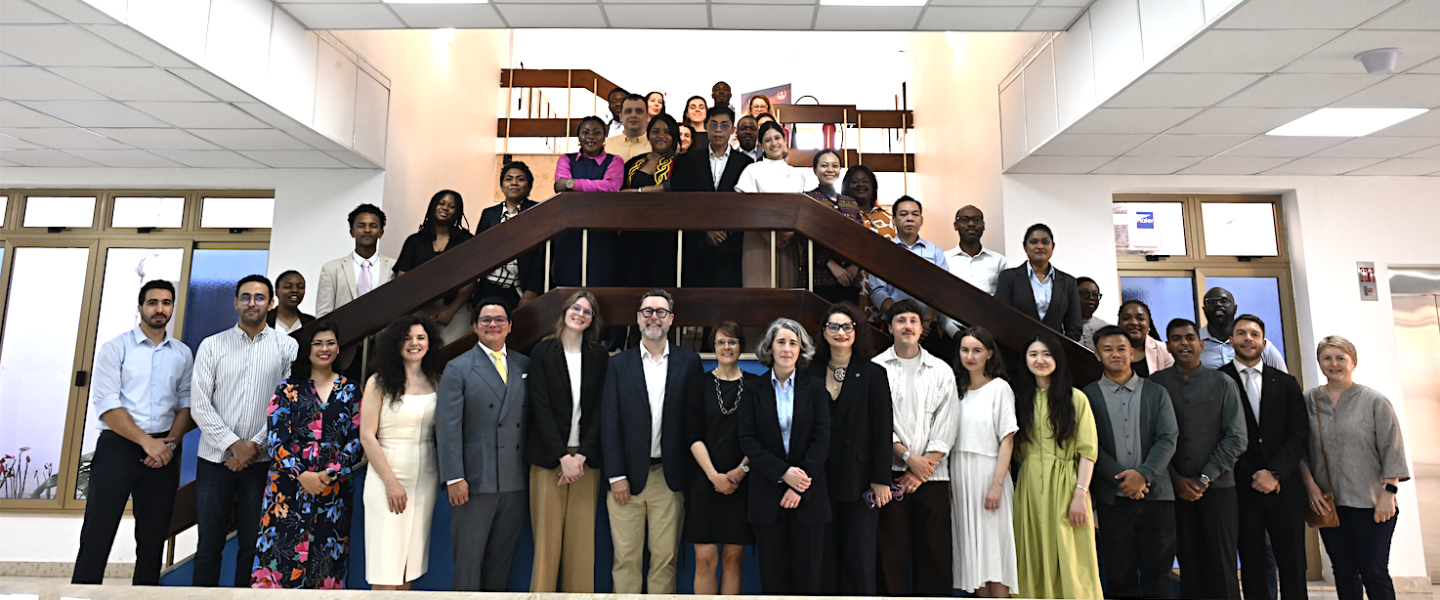
A BlueRights training programme held at the IMO International Maritime Law Institute in Malta has highlighted one of the most pressing challenges in international law: how to protect people at sea using the existing law of the sea, and maritime and human rights law when legal responsibilities are complex, fragmented and unclear.
The two-day training, delivered in May, gave participants a practical understanding of the difficulties involved in using international law to safeguard people in maritime settings.
Led by Prof Richard Barnes of the University of Lincoln/Norwegian Centre for the Law of the Sea (NCLOS) at UiT The Arctic University of Norway and Dr Jessica Schechinger of the NCLOS/UiT Faculty of Law, the training focused on the right to life at sea, especially in the context of search and rescue, the use of force, and risks and harms in the maritime workplace.
A series of mini lectures combined with practical scenarios explored the (in)effectiveness of international human rights law, the European Convention on Human Rights, the UN Convention on the Law of the Sea, many maritime instruments, humanitarian law, as well as the relationship between these legal regimes.
The training brought together early career academics and graduate students, many of whom also hold professional roles, working for coastguards, navies, government departments, or in legal practice.
“Undoubtedly the most positive aspect of the training school were the opportunities for participants to put their knowledge in to practice,” said Barnes. “We created a realistic scenario concerning search and rescue at sea and asked participants to formulate legal advice on how to address the human rights harms that were suffered by victims.”
“The feedback from the class emphasised the complexity of the legal regime and the challenge of identifying clear solutions to the problems. Some students were surprised by the lack of clarity in many key legal obligations, such as who is responsible for ensuring the safe conduct of rescue operations, what constitutes distress at sea, or when the use of force by a state’s navy/coastguard is reasonable or legitimate.”
“Another challenge identified was the inconsistency in protective regimes between different states and different standards that might apply to different states - or how individuals may have limited recourse to justice in some countries. Knowing the law is one thing, understanding how it applies in practice is another.”
The training was funded by the COST Association - European Cooperation in Science and Technology Action: Life, liberty and health: ensuring universal protection of human rights at sea (BlueRights).
BlueRights is a network of over 200 experts in areas such as international law, human rights, fisheries, shipping, and law enforcement, from across Europe and beyond.
The COST initiative recognises the lack of understanding around how to implement human rights at sea. This leads to protection gaps. Seafarers may not understand their rights. Public authorities may not understand the full extent of their duties to protect human rights or how human rights relate to other legal issues such as working conditions.
“Our work focuses on three core human rights: the right to life, the right to liberty, and the protection of health,” said Barnes. He is leading working group 1 on the right to life, which was the focus of this training school. “Besides training, networking, and engaging stakeholders, we will produce scientific publications that will help advance knowledge of the issues, as well as several non-scientific outputs – e.g. policy briefings or guidelines that can be used by policy makers or practitioners to improve how they implement human rights or take steps to improve how existing legal and policy frameworks apply.”
“To date much of our work has been educational and working with researchers, practitioners and policy-makers to better understand the state of the law, identify gaps or barriers to protection, and possibilities for improving protections.”
Blue Rights has already used conferences, workshops, and policy fora such as the UN Oceans Conference, to raise awarenes of the issues among hundreds of people who can translate their learning into practice. “I think we have been incredibly successful in this, and we are not yet halfway through the project. We are also feeding into the work of the International Law Association Committee on Protection of People at Sea, which will produce a high-level report and synthesis of legal rules applicable to protecting people at sea.”
The International Maritime Law Institute in Malta is interested in regular contributions from the BlueRights Network, so Barnes hopes to embed human rights’ perspectives into the curricula offered there, ensuring maritime professionals are even better equipped to understand and apply human rights protections at sea.
Human Rights at Sea has been a staunch supporter of the academic-led BlueRights initiative from its inception and is a core member of the EU COST Action project supporting board members and Working Groups.
ENDS.
Source: Human Rights at Sea 2026. Wendy Laursen.
Photo credit: International Maritime Law Institute (IMLI) Malta 2026.
Contact: If you have any questions, please write to us at enquiries@hrasi.org.
About Sharing. We welcome the use and dissemination of our copyrighted work with full, accurate and proper accreditation. Open Access This article is licensed under a Creative Commons Attribution 4.0 International License, which permits use, sharing, adaptation, distribution and reproduction in any medium or format, as long as you give appropriate credit to the original author(s) and the source, provide a link to the Creative Commons licence, and indicate if changes were made. The images or other third-party material in this article are included in the article's Creative Commons licence, unless indicated otherwise in a credit line to the material. If material is not included in the article's Creative Commons licence and your intended use is not permitted by statutory regulation or exceeds the permitted use, you will need to obtain permission directly from the copyright holder. To view a copy of this licence, visit http://creativecommons.org/licenses/by/4.0/.
©Copyright and Intellectual Property of Human Rights at Sea CIC (HRAS) 2025. All rights reserved.