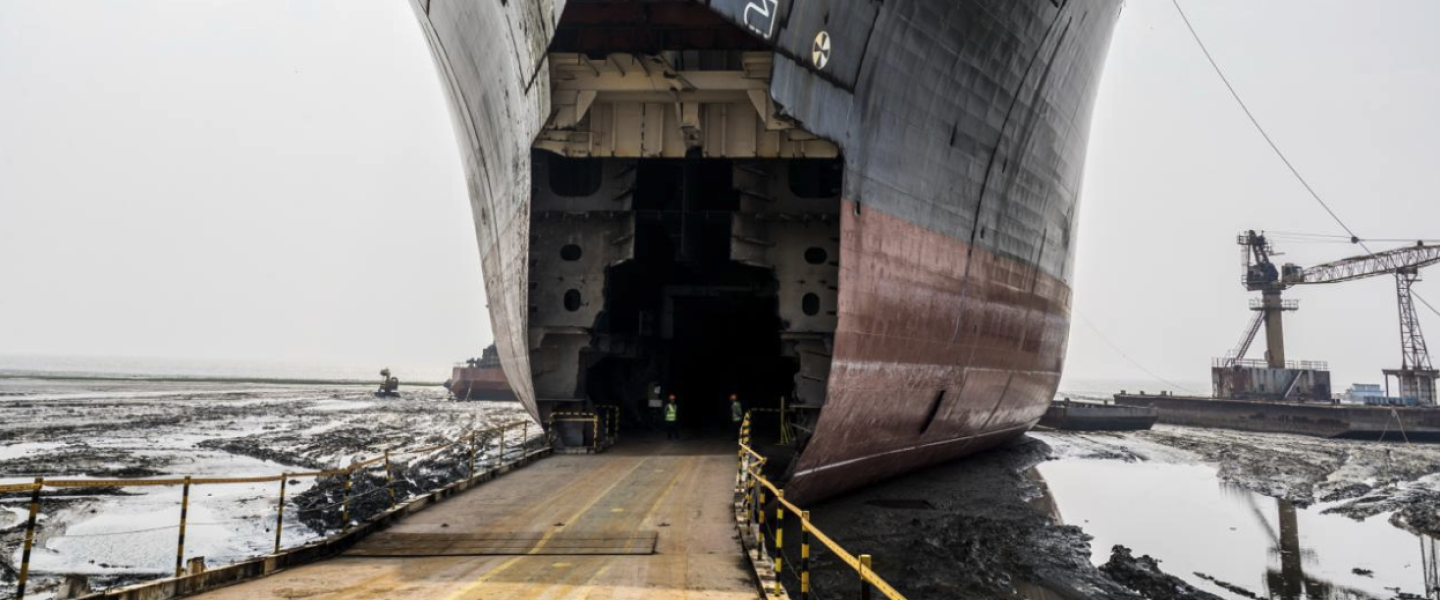
LONDON / BRUSSELS / BANGLADESH 24 August 2026. The prevention of deaths in enclosed spaces has proven to be an intractable problem for the maritime industry. The recent case involving the deaths of nine workers in a Bangladesh shipbreaking yard is another example of this. It is also an example of another intractable problem, the on-going death toll of workers in South Asian yards.
Both risks have been the subject of increasingly sophisticated regulations dating back over 20 years: the UN, IMO, and ILO, amongst others, have sought to protect workers from the specific risks of working onboard ships.
In this most recent case, these efforts failed.
On 14 August, nine workers died after exposure to toxic gas inside the LNG carrier Rasi (IMO 9176008) at Ferdous Steel in Chattogram, Bangladesh. Among those killed was a 17-year-old. Several other workers were injured.
The workers were cutting a hole into a ballast tank when hydrogen sulphide gas escaped into the adjacent enclosed area they occupied. Media reports indicate that first responders also found high concentrations of ammonia and methane.
It has been alleged that the Rasi was dismantled without the required gas-free certification, and the Bangladesh Environmental Lawyers Association (BELA) issued a legal notice demanding an independent investigation into the deaths and immediate suspension of all operations at the yard.
Three committees have already been formed to investigate the accident, including one by the Bangladesh Ship Breakers and Recyclers Association and another by the Ministry of Industries. BELA questions the neutrality of these investigations, arguing that the shipbreaking association represents the interests of yard owners, while the Ministry of Industries is involved in approving the import and dismantling of vessels.
BELA has blamed weak legal provisions and inadequate enforcement for the recurrence of fatal accidents at the yard in question, noting additional deaths and injuries among workers at the Ferdous Steel yard from January 2010 to August 2026.
An estimated 84 accidents have occurred at Bangladeshi yards since the Hong Kong Convention entered into force in June 2025, leaving 15 workers dead and 81 injured.
The NGO Shipbreaking Platform highlights on-going deaths in the wider South Asian industry which it says underline how the Hong Kong Convention establishes a weaker global baseline than the obligations of the Basel Convention, which is designed to prevent hazardous waste from being exported to countries unable to manage it in an environmentally sound manner.
"Hazardous end-of-life ships should not be exported for recycling where environmentally sound management cannot be guaranteed. Yet, due to weak enforcement, vessels continue to be sent to South Asian beaches despite recurring deaths, pollution, and serious deficiencies in hazardous waste management. Certifications must not become a licence to continue business as usual," says Ingvild Jenssen, Executive Director of the NGO Shipbreaking Platform.
Barrister James Turner, a specialist in shipbuilding and marine casualties at Quadrant Chambers in the UK, says: “The enforcement of the Hong Kong Convention, so far as concerns worker safety, is entirely down to the recycling state: here, Bangladesh.”
He says, the Convention itself has relatively little to say on the topic, although he cites other relevant regulations including the IMO’s 2012 Guidelines for safe and Environmentally Sound Ship Recycling and the ILO’s 2004 Safety and health in shipbreaking guidelines for Asian countries and Turkey.
International regulation has continued to mature since these early guidelines with, for example, the IMO’s June 2025 resolution: MSC.581(110) Revised Recommendations for Entering Enclosed Spaces Aboard Ships.
These developments come as the death toll continues. InterManager has estimated that around 350 seafarers and third-party workers have died from asphyxiation in enclosed spaces onboard ships since 1996. The number of enclosed space accidents occurring on an annual basis has not reduced significantly since 1998 when InterManager began compiling statistics.
David Hammond, founder of Human Rights at Sea (HRAS) joins the call for independent, thorough and timely investigation of the deaths in Bangladesh, but also notes that statistics such as these highlight the widespread safety issues that continue to confound the industry at large.
“The dangers facing workers in enclosed spaces on ships stretch beyond a single ship, single yard or single country,” he says. “The global maritime industry must maintain pressure on the regulators involved in this case to ensure that the causes are fully understood and then disseminated as a matter of urgency so that we can build a working environment for all that avoids similar occurrences in the future. Meanwhile, our condolences go out to the family and friends of the victims of this tragic incident.”
References:
https://shipbreakingplatform.org/nine-shipbreaking-workers-killed-in-bangladesh/
https://intermanager.org/enclosed-space-survey-aims-to-understand-why-seafarers-are-still-dying/
https://www.dnv.com/news/2026/revised-imo-recommendations-for-entering-enclosed-spaces-aboard-ships/
ENDS.
Source: Human Rights at Sea 2026.
Photo credit: NGO Shipbreaking Platform 2026.
Contact: If you have any questions, please write to us at enquiries@hrasi.org.
About Sharing. We welcome the use and dissemination of our copyrighted work with full, accurate and proper accreditation. Open Access This article is licensed under a Creative Commons Attribution 4.0 International License, which permits use, sharing, adaptation, distribution and reproduction in any medium or format, as long as you give appropriate credit to the original author(s) and the source, provide a link to the Creative Commons licence, and indicate if changes were made. The images or other third-party material in this article are included in the article's Creative Commons licence, unless indicated otherwise in a credit line to the material. If material is not included in the article's Creative Commons licence and your intended use is not permitted by statutory regulation or exceeds the permitted use, you will need to obtain permission directly from the copyright holder. To view a copy of this licence, visit http://creativecommons.org/licenses/by/4.0/.
©Copyright and Intellectual Property of Human Rights at Sea CIC (HRAS) 2026. All rights reserved.