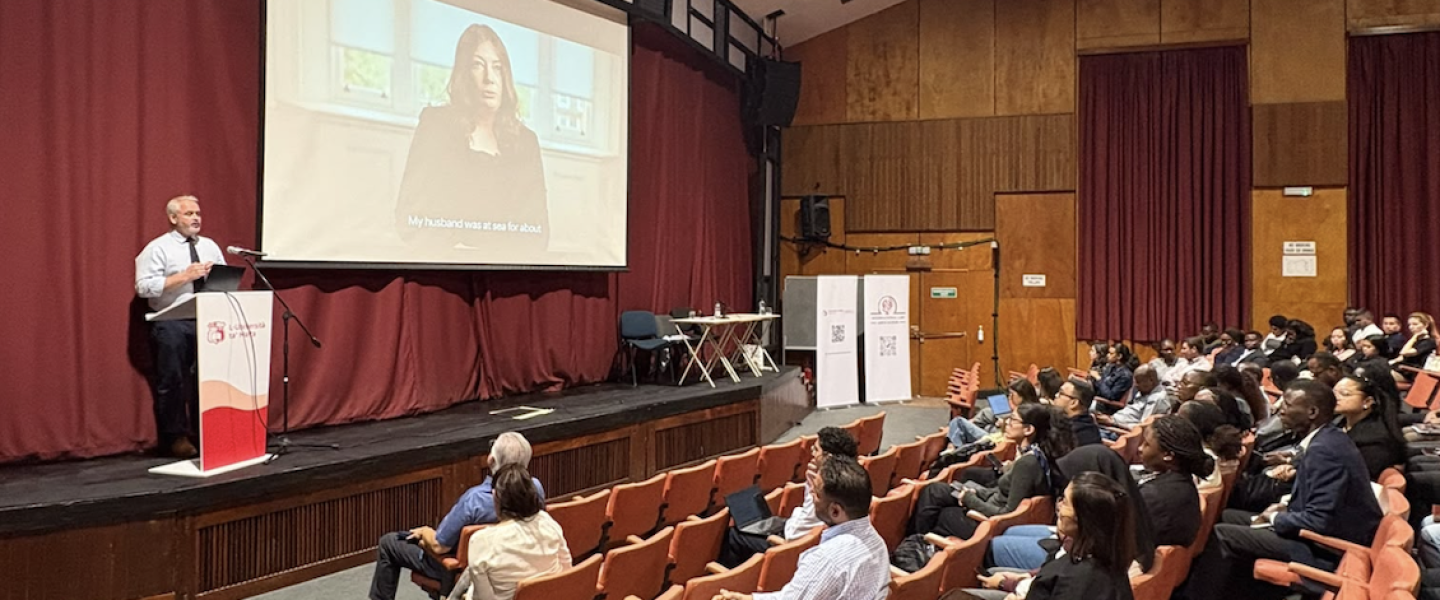
Malta 29 October 2026. Human Rights at Sea Founder, David Hammond Esq., has given the Lectio Magistralis ‘Frontline Realities of Protecting Human Rights at Sea. Albokhari, Bekavac and Others' to a gathering of the International Law Association (Malta), Fellows, staff of the University of Malta, and Directors and Scholars of the International Maritime Law Institute (IMO-IMLI).
The full text is reproduced below and is available for download.
I. Opening
My compliments to the President of the International Law Association Malta Branch, Distinguished Directors and Faculty of the IMO International Maritime Law Institute, Eminent Jurists, Learned Colleagues and to the attending Master’s Scholars and undergraduate students who must become the thin line of responsible oversight in maritime jurisprudence.
To address this joint assembly here in Malta is a profound responsibility for me.
Malta is not merely an island in the Mediterranean; it is a historic and contemporary regional centre where public international law and specialized maritime law historically intersect.
Yet, let us be entirely clear from the outset: we are not gathered here today to engage in academic self-congratulation, nor are we here to indulge in the comfortable corporate solidarity that satisfies so many international maritime initiatives and conferences.
For too long, the maritime sector has been rife with heartfelt words of temporary new leaders, bureaucratic social initiatives designed to pursue vested interests’ narratives, and hollow declarations of "intent and being on a journey" to commit to support workers.
Meanwhile, the void between corporate intention and frontline action remains largely unaddressed in terms of rife impunity, lack of accountability and a lack of a healthy sprinkling of mea culpa.
Today, we pull back the thin veneer.
We turn our attention to the vast, blue, (and as my US colleague, Ian Urbina, would categorise), lawless expanse that covers over seventy per cent of our planet to confront a systemic, ugly, and unspoken paradox: the flagrant abuse and systematic criminalisation of not just individuals but of the fundamental protections born from the concept of assured access to human rights at sea for all.
My core thesis today is unapologetically raw, challenging, and positioned in parts as non-negotiable - primarily because human rights attach to the person, not the floating steel hull, the corporate registry, or the stone beneath our feet here on land.
They belong to individuals by virtue of their humanity, and they do not dilute, distort, or evaporate the moment a vessel leaves the confines of the port, or territorial waters.
As I laid out at the start of our civil society Human Rights at Sea journey in 2014, ‘Human rights apply at sea, as they do on land’.
That, for me and us must be a non-negotiable starting and foundational position.
Reflecting the universality of fundamental rights, I argue that the law of the sea must be challenged of its economic exceptionalism and selective interpretation - often based on the ‘might is right’ approach by dominant states and updated to reflect modern societal norms.
As international lawyers and future counsel in this room, our duty is to challenge and enhance what could be described as the fog that treats the ocean as a convenient arena enabling both commercial and state impunity.
II. Philosophical & Historical Framework: Grotius vs. The Reality of Human Invisibility
To understand why we are operating in a continuously failing model of human visibility, we must become comfortable with the uncomfortable and challenge our legal ancestry.
For four hundred years, ocean governance has been trapped in a property-centric and commercial focus. Arguably, we are inducted to revere Hugo Grotius and his 17th-century doctrine of Mare Liberum – ‘the freedom of the sea’. But as jurists, scholars and practitioners we should have the courage to ask an unpopular question:
What did "freedom" mean to Grotius?
Did it mean freedom for sustained commercial exploitation? Did it mean freedom for colonial transit of ideas, goods (including trafficked human beings) or advancing of technological services?
Was it a space designed for the enrichment of states and commercial entities while explicitly blinding human beings to being consistently exploited both then and now?
In parallel, when our modern framework of International Human Rights Law (IHRL) emerged from the ashes of the Second World War via the 1948 Universal Declaration, it developed with an ingrained terrestrial bias. The architects of the post-war order drafted law and policy for citizens within borders establishing today’s precedent - and leaving the human being at sea effectively invisible. Today, we regularly speak of ‘sea blindness’.
So what?
We should challenge this historical divide between IHRL and UNCLOS and the routes to individual and corporate enrichment through exploitation.
The principle of universality means exactly what it says: human rights belong to every member of the human family.
There is no maritime exclusion clause.
If human rights are truly universal, they must remain robust and robustly defended across every supply and value chain.
III. Contemporary Legal Dilemmas: Is UNCLOS Fit for the 21st Century?
Let us refer to the foundational texts.
The 1982 United Nations Convention on the Law of the Sea (UNCLOS) celebrated as the "Constitution of the Oceans" is a monumental achievement of international spatial co-operation and organisation. Yet look closely at its 320 articles and the term "human rights" does not explicitly appear. Rather UNCLOS ports in the protection of human rights as part of a recognised framework convention. You could say that UNCLOS treats a ship as a piece of transactional property, an extension of state sovereignty or corporate enterprise, rather than a working community of human beings.
This structural omission by UNCLOS represents, what the late Professor Steven Haines masterfully argued, was a catastrophic example of fragmentation in international law. While the 1970s saw parallel expansions in ocean governance and IHRL grow in institutional siloes.
This past structural integrity of such silos and the maritime rules-based environment is actively cracking under modern pressures and societal evolution.
On a side note - AI and atomisation of shipping and supply chains will be the next technological leap forward - and potentially the death nail of human rights’ protections at sea – we will see.
Meantime, we can look to the landmark 2022 UK House of Lords Inquiry conducted by the International Relations and Defence Committee, titled UNCLOS: the law of the sea in the 21st century (See Chapter 5: Human Rights and Labour protections at sea)[1].
The Inquiry explicitly interrogated whether the 1982 framework remains fit for purpose – especially when confronted with modern challenges that its architects did not anticipate. (How could they with the current speed of societal change?).
The findings of the House of Lords Inquiry and its subsequent parliamentary debate deliver a poor indictment of our current maritime architecture:
- The Climate Migration Crisis: The Committee highlighted that climate change and sea-level rise are destabilizing ambulatory baselines and fuelling unprecedented climate-induced migration. UNCLOS contains no legal infrastructure to protect maritime displaced persons.
- The Erosion of the Duty to Rescue: The Lords explicitly observed that the maritime duty to rescue those in distress at sea is being systematically sidelined by restrictive domestic migration policies fuelled by national interests.
- The Flags of Convenience Vacuum: The report challenged the extensive use of open registries (or flags of convenience) concluding that they create a high-seas regulatory vacuum that directly facilitates human rights abuses, modern slavery, and maritime insecurity.
As the Lords' debate warned, if UNCLOS is not urgently supplemented and developed via updated and robust international mechanisms, it will cease to be fit for purpose in the 21st century. This systemic fragmentation also fractures the chain of accountability, allowing bad actors to hide behind the absolute primacy of flag-state jurisdiction under Article 92.
In this void, corporate and state impunity thrives.
IV. Mechanics of Impunity: Flag State Deficits and Regulatory Failure
The persistent impunity of poor-performing flag states remains a scandal within public international law. While Article 94 of UNCLOS ‘Duties of the Flag State’ mandates that every state shall effectively exercise its jurisdiction and control in administrative, technical, and social matters over ships flying its flag, the commercial reality often tells a different story.
The mechanism of Port State Control and the regional enforcement reporting mechanism provided by the Paris and Tokyo Memorandums of Understanding (MOUs) exposes this failure annually through its reporting.
The Black, Grey, and White flag lists published by these MOUs are not mere statistical metrics; they are an explicit mapping of governance failure. Some may say, lawlessness.
Flag states that consistently sit on the Black and Grey lists have turned sovereign registration into a highly lucrative commercial commodity, actively selling their flag to often anonymous shell companies while arguably possessing no intent and little to no capacity to police what happens on those registered vessels.
This regulatory breakdown feeds into a total lack of accountability for vessel owners and operators who act unlawfully.
Because international maritime governance relies almost entirely on the flag state to initiate criminal proceedings, an owner can exploit, starve, and abandon a crew with near-absolute safety. If a shipowner breaches the Maritime Labour Convention (MLC) 2006, the maximum penalty is usually an administrative fine or a commercial detention by Port State Control - a minor and rather convenient cost of doing business.
The thin line of deterrent is often the local union officials and welfare organisations – themselves predominantly charitable and volunteer in construct and operation.
Worse still, as international jurists, we face a lack of recent common law precedent cases.
Why?
Because there is an appalling low level of domestic state prosecution targeting vessel owners for corporate human rights abuses. Coastal and port states readily arrest deck crew members or senior officers when contraband is found.
Yet those same states possess zero appetite to initiate complex, cross-border corporate manslaughter or slave-labour prosecutions against beneficial owners hiding behind tiers of corporate anonymity.
Without state prosecutions, our judicial systems fail to generate the binding legal precedents required to act as a hard, deterrent effect.
Perversely, the legal system effectively enforces the rules against the victim while protecting the true financial architect of the crime.
V. Frontline Realities: The Criminalisation of Seafarers as Disposable Assets
Nowhere is this chaos more apparent than in the expanding crisis of the criminalisation of seafarers. Commenting directly on these dynamics for a Middle East publication, I have stated an inescapable and uncomfortable truth that defines our modern era:
“Undeniably seafarers are disposable assets. Disposable because they can be easily replaced but concurrently, assets for assuring continuous global movement of goods by sea. I do not see this status quo changing anytime despite justifiable industry protestations that seafarers should not be targets during armed conflict, nor subject to criminalisation when unknowingly exploited by organised crime groups, owners or operators, for example.”
In our multi-trillion-dollar maritime supply chain, ordinary mariners are routinely sacrificed as public scapegoats for transnational cartels. Rather than pierce the veil of anonymous corporate shipowners, coastal and port state authorities find it easier to prosecute the visible crew who happen to be onboard.
Let us look past the sanitised corporate press releases and confront three frontline examples of this legal failure:
1. The Phoenician M and the Living Hell of Ali Albokhari
As documented in the August 2026 Human Rights at Sea Independent Review, the bulk carrier Phoenician M stands as a watershed of judicial failure and what we say, is an unsafe conviction within a European state.
In September 2023, while loading coal in Barranquilla, Colombia, Captain Marko Bekavac explicitly warned his Turkish managers about severe security vulnerabilities from local cartels. Corporate management ignored the request and failed to provide physical locks or surveillance. Colombian authorities subsequently found 137 kilograms of cocaine blocks hidden in an aft peak tank. No crew members were arrested because there was no evidence linking them to the cargo, and the vessel was cleared to sail after the underwater inspection in an outer anchorage.
Yet, when the ship docked in Ereğli, Türkiye, a second cache of cocaine was allegedly found buried deep within Hold No. 2. Turkish authorities applied a blanket rule of "command responsibility," confusing commercial rank with personal criminal liability. Captain Bekavac and Chief Officer Ali Albokhari were sentenced to 30 years in prison without a single fingerprint match, communications log, or piece of forensic evidence linking them to the international smuggling ring and cartel activities.
The structural disparity that followed is shocking.
While diplomacy through a prisoner swap secured Captain Bekavac's return from Türkiye to Croatia in August 2025, Chief Officer Ali Albokhari, a Finnish national of Syrian birth remains incarcerated in a Turkish prison cell.
In July 2026, both men’s sentences were extended to 33 years because they refused to pay judicial fines; an act that would have been legally treated as an admission of guilt.
Worse still, Turkish prison authorities have subjected Albokhari to severe mental torture, threatening an involuntary transfer to Finland to serve out this unsafe sentence before his extraordinary Article 308 appeal can even be heard by the Constitutional Court. Two dissenting Supreme Court judges openly highlighted that the investigation flawed, noting that the Turkish courts failed to examine the Colombian files, ignored source intelligence, and shielded the true Turkish commercial recipients of the drugs.
Yesterday, Ali Albohkari’s cell mate hung himself but was revived by prison staff.
2. The Isolation of the Harbour Phoenix crew in Iran
Look further East to the case of the Palau-flagged oil products tanker Harbour Phoenix. In July 2025, Iranian state authorities seized the vessel, throwing its 10-member Indian crew into the notorious Bandar Abbas jail. Among them was Aniket Singh, a mariner who went to sea simply to earn a livelihood to support his family in Uttar Pradesh.
For over a year, these men languished behind bars with zero clarity on legal charges, zero transparency regarding judicial timelines, and severely restricted communication with their families.
The Harbour Phoenix highlights the pattern of automatic criminalisation. These mariners do not own the cargo; they do not charter the vessel; they do not dictate its transit passage. Yet, when state interests, rivalries or sanctions enforcement ignite, the seafarer is jailed, isolated from home-state consular access, and discarded.
3. The MV Harris and the Hypocrisy of Justice in Algeria
On July 28, 2023, Algerian authorities boarded the vessel MV Harris and discovered 35.8 kilograms of cocaine left out on the open deck; an area entirely accessible to shore personnel and passengers while the ship was in transit.
Eight Filipino crew members were arrested and taken into custody.
In February 2026, an Algerian court handed down a 10-year prison sentence to three remaining Filipinos: the Chief Officer, the Bosun, and an Ordinary Seaman.
The trial of the MV Harris crew exposes a staggering double standard that destroys any claims of logical jurisprudence.
The Croatian captain of the vessel was completely excluded from arrest and prosecution, completely turning the traditional doctrine of command responsibility on its head.
Five of the Filipino crew members were permitted to return home, while these three selected crew members were, in my language, left to rot behind bars.
VI. "Others": Protecting Crew Lives and the Ultimate Price at Sea
But if we are truly to understand the total parameters of maritime lawlessness we must extend our analytical landscape beyond unjust convictions and corporate abandonment.
We must look at the dark finality hidden beneath the title of "Others" - the frontline reality of protecting crew lives, where human rights failures do not result in prison sentences, but in yet unpunished loss of life.
Let us confront the brutal reality of the murder of the superyacht crewmember and South African national Paige Bell.
At age 20, Paige was tragically murdered while working onboard a superyacht in the Bahamas in 2025.
Two mothers linked to the Bell family, Charni Johnson and Nikki Coetzer, are working to help other superyacht crewmembers worldwide understand the risks, their rights, and their responsibilities – in her memory through the crew platform ‘Protecting Crew Lives’.
Let us look furthermore at our independent review conducted into the death of Kiribati fisheries observer Eritara Aati Kaierua.
On March 5, 2020, Eritara was officially reported dead while performing critical conservation enforcement duties aboard the Taiwanese-flagged fishing vessel Win Far No. 636. His family was left to receive his body along with a wall of institutional silence.
The independent investigation conducted by Human Rights at Sea exposed a devastating catalogue of procedural failures:
- The Evidentiary Gaps: Shortcomings in crime scene management by the Kiribati Police Service and a total lack of in-country forensic resources destroyed the reliability of the initial investigation.
- The Suppression of Evidence: Crucial electronic evidence and IT devices were completely withheld, and the facts relating to his post-mortem reviews were hidden from his legal representatives.
- Corporate Collusion and State Complicity: Most appallingly, the crime scene itself, the vessel, was released on request by the commercial owners to continue fishing in surrounding waters while forensic trails were systematically obliterated by the sea.
As his sister shared in her devastating impact statement, the family was left alone to imagine the terror and isolation he faced fighting for his life, cut off from help in the middle of an empty ocean.
VII. The Power of Family Advocacy: The Tenacity of Elena Albokhari
When we examine these frontline realities, we must look past the institutional architecture and confront the human forces fighting back against corporate and state indifference.
When flag states hide behind jurisdictional smoke screens and international shipowners quickly rebrand their companies to keep trading, it is the families left on land who are forced to carry the weight of legal failures.
Nowhere is the power of human leadership, tenacity, and relentless persistence more brilliantly illustrated than in the fight spearheaded by Elena Albokhari in defence of her husband, Ali.
For nearly three years, Elena has refused to accept the passive status of a victim.
Faced with an international system that offers a mere "one per cent chance" of successfully fighting a state-level narcotics conviction, she has kept the narrative of her husband’s innocence alive in the global public eye.
Armed with the stark, unyielding philosophy that "crying won't save my husband," she has stepped into the breach where diplomatic bodies and corporate institutions have failed to meaningfully act.
When the Finnish government provided only limited consular contact, and when major maritime bodies failed to extend meaningful advocacy despite repeated written pleas, Elena refused to stay silent.
She rightly forced her way into international media channels, directly engaged the Secretariat of the International Maritime Organisation in London, challenged international unions, and systematically brought together civil society organizations to weaponise the truth.
Elena Albokhari’s relentless campaign demonstrates a critical lesson: when the rule of law at sea breaks down, family-led advocacy becomes a vital, disruptive mechanism of frontline accountability.
VIII. Market Leverage vs. Corporate Self-Preservation: The Insurance Asymmetry
To construct a truly comprehensive framework for human rights at sea, we must evaluate the immense latent power of global corporate architecture—specifically, marine insurance and re-insurance entities.
As highlighted during the Marine Insurance Nordics Conference in Oslo in 2023, civil society is increasingly driving a paradigm shift within the insurance sector.
Underwriters hold an extraordinary economic lever: they possess the unilateral power to deny or withdraw cover, effectively freezing any vessel out of global commerce.
Consequently, marine insurers have the commercial capacity to isolate shipowners, operators, and entities that undertake bad business practices, exploit seafarers, or participate in illegal trafficking networks.
This was explicitly detailed in the "Crew Matters" fireside chat featuring then Gard’s Chief Risk Officer, Torunn Biller White, which showcased how civil society can push corporate risk frameworks to acknowledge human rights impacts.
However, this commercial leverage faces deep structural challenges. Marine insurance mutual associations, the Protection & Indemnity (P&I) Clubs, were historically founded by shipowners, for shipowners, to pool third-party liabilities.
Their primary legal and fiduciary duty is to represent and defend the owner, not the individual crew member.
This creates a severe conflict of interest when crimes occur at sea.
As documented in the Phoenician M and MV Harris crew testimonies, when port state authorities board a vessel, the local P&I club-appointed legal counsel encourages the crew to sign arrest warrants written in languages they do not understand, simply to expedite the procedural uncoupling of the ship from the criminal case so it can resume commercial trading. The crew signs, the ship leaves, and the individual mariners are abandoned in maximum-security cells.
IX. The Philosophical Counterargument: Is the Geneva Declaration a Legal Principle or an Unenforceable Proposition?
Faced with these persistent legal failures and corporate asymmetries, we must look critically at the modern norm-building mechanisms designed to correct them.
This brings us directly to The Geneva Declaration on Human Rights at Sea (GDHRAS)[2], an instrument drafted in part by the late Professor Steven Haines and trail-blazing colleagues Anna Petrig, Irini Papanicolopulu, Sofia Galani and Elizabeth Mavroupoulo.
The Declaration asserts as its first foundational pillar that” “Human rights are universal; they apply at sea, as they do on land.”
But as public international lawyers know, we must step out of the realm of aspirational sentimentality and interrogate this text.
We must confront structural counterargument: the founding principle of the Geneva Declaration is not a "principle" in the recognized legal sense of international law, but rather a conceptual proposition that remains actively open to state challenge.
The real challenge will be to do so without fundamentally undermining directly or indirectly the foundations of the human rights at sea movement.
Under Article 38(1)(b) of the Statute of the International Court of Justice, "Customary International Law" must be recognized by nations through consistent state practice and opinio juris.
The Geneva Declaration does not yet possess either.
It is a soft law initiative generated entirely by civil society and academia. It represents lex ferenda: the ideal, proposed, or desired rules that do not yet have binding legal force representing policy goals, legislative recommendations, or academic arguments for how the law ought to change (the law as it ought to be), not lex lata, referring to positive law -"the law as it currently exists", and is enforced.
Therefore, when the Declaration states that human rights apply at sea as they do on land, it is advancing a progressive maritime thesis, not a binding rule of customary international law.
Port and coastal states can challenge this proposition. They can argue that the high seas constitute a distinct spatial regime where traditional land-based constitutional protections are fundamentally altered by the architectures of maritime sovereignty and flag-state supremacy.
When states act with such absolute disregard for human dignity, they are actively demonstrating the reality that I summarized in my second stark warning to the same Middle East media publication:
“In a fractured world with rampant impunity, the established international rules-based systems including maritime law and the freedom of navigation are veneer thin in terms of holding persons and entities accountable for unlawful actions. Today, there is little deterrent effect for deliberately putting seafarers in harm's way and so, the pattern of exploitation will continue unabated.”
X. Academic Evolution: The EU COST Action BlueRights Initiative
If we are to move this contested proposition into the realm of enforceable law, academia must partner directly with policy enforcers.
This is precisely the value of the recent EU COST Action BlueRights Initiative[3] (Life, liberty and health: ensuring universal protection of human rights at sea). As showcased at the international conference in Budva, Montenegro, chaired by Prof. Dr. Senka Šekularac-Ivošević, multidisciplinary experts from 39 countries are working to bridge the gap between abstract regulations and frontline reality.
The research output of the BlueRights framework cuts through corporate behaviours, calling for:
- Strengthened, mandatory enforcement mechanisms for the Maritime Labour Convention (MLC) 2006, particularly protecting non-EU seafarers.
- Rigorous pre-signing education on Seafarer Employment Agreements (SEAs) to ensure formal, judicial validity before mariners’ board.
- Institutionalised psychological and peer-support programs to manage burnout, stress, and crisis leadership.
- The translation of these academic findings into direct policy briefs submitted straight to the IMO Legal Committee.
This is the pathway through which academic doctrine can become operational state practice.
XI. A Roadmap for Enforceable Accountability
We must stop talking and move toward concrete, adversarial legal action to disrupt this cycle of state and corporate impunity. The roadmap forward requires three immediate transitions:
1. We must force national and international tribunals to interpret UNCLOS dynamically alongside international human rights law. An inspection or detention under the guise of port state control is a violation of international law if it ignores the fundamental right to liberty and due process codified in the ICCPR and the European Convention on Human Rights.
2. We must actively deploy internal correction mechanisms within domestic courts to defeat arbitrary prosecution. In January 2025, the Turkish Supreme Court Criminal General Assembly issued a landmark ruling in the Shandong De Rui case. The court explicitly held that the presence of contraband on a vessel does not automatically establish crew involvement, and that senior rank cannot replace forensic proof of criminal intent (Kast). This precise precedent is the core anchor of the pending Article 308 CMK petition for Ali Albokhari.
3. We must advocate for international standards that hold P&I clubs and re-insurers transparently accountable for the legal representations they deploy on the front lines through correspondents. If an insurer's legal correspondent sacrifices the fundamental human right to liberty of a ship's crew arguably to minimise commercial detention costs for the hull owner, that action must be exposed to civil liability and human rights litigation in terrestrial courts.
XII. Conclusion and Call to Action
The global human development system is not broken; it is working perfectly for those elite corporate and state entities that profit from the exploitation of workers who just want to earn a basic living wage.
We live in a multi-trillion-dollar maritime supply chain where billionaires accumulate massive wealth while ordinary mariners and fisheries observers have been and are treated as disposable assets.
We can track cargo instantly across five oceans with blockchain systems, AI oversight and increasingly minimal human input.
We can penalize a shipowner millions of dollars within an hour if litres of fuel spill into a harbour. Yet we stand by as human beings are exploited, physically beaten, enslaved, unjustly criminalised, and as exposed by investigative journalists and civil society, left to die alone on the high seas in the case of migrant workers in foreign fishing fleets.
The ongoing incarceration of Ali Albokhari in Türkiye, the reported abandonment of Aniket Singh in Iran, and the yet unpunished deaths of Paige Bell and Eritara Aati Kaierua are a direct challenge to our collective legal imagination and moral will.
But the leadership of advocates like Elena Albokhari, the research of the EU Cost Action BlueRights initiative, the interventions by union inspectors and welfare organisations all remind us that the line can be held.
As members of the International Law Association Malta, scholars of university and the International Maritime Law Institute, you stand at the precise point where global policy is developed and honed.
You have the tools, the heritage and the intellectual authority to rewrite this narrative - which I hope you will step up to and take forward.
Let us resolve that the blue frontier will no longer be an arena of structural impunity.
Together, let us build a jurisprudence that ensures that the law of the sea becomes, once and for all, a law for all people living, working, transiting at sea without exception.
Thank you.
ENDS.