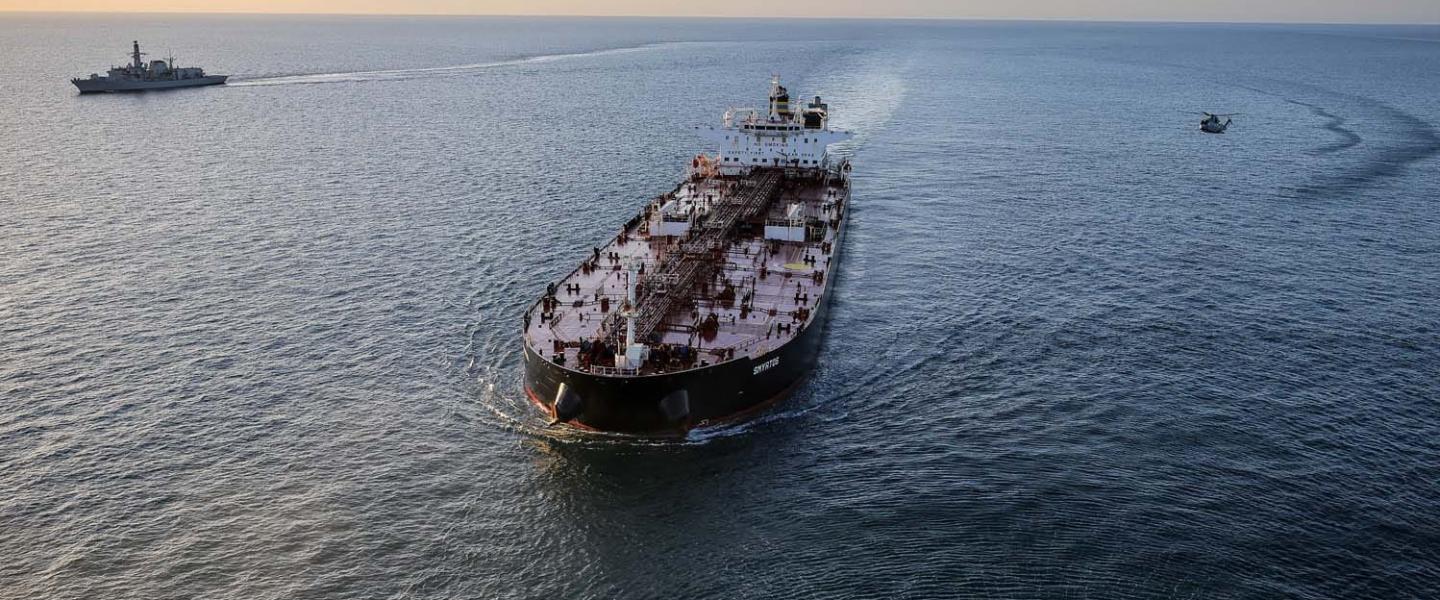
MV Smyrtos Case
- Smyrtos master Ajay Pant has been denied bail and will remain in custody ahead of a December trial over alleged sanctions breaches linked to the first shadow fleet tanker seized by the UK
- The case is expected to become a key test of the UK’s willingness to pursue criminal prosecutions against individual seafarers, rather than focusing solely on vessel owners and operators
- Industry observers warn the prosecution could redefine the balance between corporate responsibility and personal liability as governments intensify enforcement against Russia’s shadow fleet
The UK’s prosecution of Ajay Pant, captain of the seized shadow fleet tanker Smyrtos, is shaping up to become a landmark sanctions case that could test whether individual seafarers can be held criminally liable for their role in Russia’s shadow fleet operations. David Hammond, founder and executive director of Human Rights at Sea International attended Southwark Crown Court as an independent observer, and reports on the case for Lloyds List.
Original copy: Lloyds List 17 July 2026. Reproduced with permission.
The Indian master of a Russian shadow fleet* tanker seized by the UK is set to stand trial in December after being refused bail, in a case that could become one of the most significant maritime sanctions prosecutions in recent years.
Captain Ajay Pant, 38, master of the Smyrtos (IMO: 9389100), appeared by video link before Southwark Crown Court on Thursday. His application for bail was denied and he remains in custody, having been remanded since the vessel was intercepted by UK authorities on 14 June.
The case carries implications far beyond the fate of a single ship, its cargo or its master.
It is likely to become an early test of how far Western governments are prepared to use criminal sanctions enforcement not only against shadow fleet operators, but also against the seafarers who work aboard their vessels.
The trial is subject to further applications by both the prosecution and defence.
Meanwhile, the Smyrtos remains anchored off Weymouth on the Dorset coast. The vessel’s crew are still onboard pending a planned crew change this weekend. According to the UK Department for Transport, responsibility for repatriating the crew rests with the shipowner.
The vessel’s detention marked a watershed moment in the UK’s campaign against Russia’s shadow fleet. British forces intercepted the tanker in the English Channel, making it the first shadow fleet vessel seized by the UK.
Elsewhere in Europe, authorities have detained stateless tankers, imposed penalties and ultimately released the ships.
The UK’s approach has gone further.
Rather than focusing solely on the vessel or its owners, the Crown Prosecution Service elected to bring criminal charges against the ship’s master.
The Smyrtos was among 36 sanctioned tankers removed from the Cameroon register after sustained pressure from European sanctions officials on flag states to deregister shadow fleet operators. Its lack of valid registration formed a key element of the legal rationale under the United Nations Convention on the Law of the Sea that enabled authorities to board and detain the vessel.
At the time of its seizure, the tanker was owned by Chinese company Zhao Yao Shipping Limited, which also controlled the shadow fleet tanker Adhara (since renamed Mezen) (IMO: 9353125).
For now, Capt Pant remains on remand at Winchester Prison. But the significance of the case extends well beyond questions of bail or the future of a single tanker.
For the UK government, the prosecution sends a clear signal that sanctions enforcement is moving from designation lists to criminal accountability.
Economic sanctions only have value if they can be enforced, and visible prosecutions serve both punitive and deterrent purposes. The intended audience extends well beyond vessel masters to owners, operators, managers, charterers and facilitators involved in shadow fleet trades.
Yet the case also raises an uncomfortable question for the maritime industry: where should the line be drawn between corporate responsibility and individual criminal liability?
Commercial decisions relating to vessel employment, chartering arrangements, ownership structures and trading patterns are typically made far from the bridge. When enforcement action occurs, however, it is often the master who is most visible, most accessible to authorities and most vulnerable to detention.
That does not absolve masters of responsibility. Command authority carries significant legal obligations, and many would argue that officers serving aboard sanctioned or stateless vessels cannot be unaware of the associated risks.
Nevertheless, the prosecution highlights growing concern that the burden of sanctions enforcement may be falling increasingly on individual seafarers rather than the networks that organise and profit from shadow fleet operations.
The human consequences are already apparent. According to his wife, Capt Pant has struggled with imprisonment and has found the prison environment intimidating. At the time of writing, she had yet to obtain a visa to travel to the UK to visit him. The family now faces months of uncertainty while the case proceeds, although consular officials and maritime welfare organisations are providing support.
The wider industry is watching closely because the implications reach far beyond a single prosecution. Shadow fleet trading has already challenged established norms of maritime governance, sanctions enforcement and regulatory oversight. Governments are now responding with increasingly assertive measures.
Whether that approach proves necessary, effective and legally sustainable will ultimately be tested in court. Whatever the outcome, one conclusion is already clear: the Smyrtos case is evolving into something much larger than an alleged sanctions breach by a single ship’s master.
It is becoming a test case for how far states are prepared to use criminal law against individual seafarers in pursuit of broader geopolitical objectives. The maritime industry would be wise to pay attention.
ENDS.
Photo credit: MOD Royal Navy.
UK Ministry of Defence Press 14 June 2026